Based in Staines-upon-Thames
24/7 Emergency Tree Workin Staines-upon-Thames
A cracked limb or a tree leaning over a roof does not wait for office hours. We assess the danger, make the site safe and remove what needs to come down, then invoice once the job is complete.
The service
What emergency tree work covers
Emergency tree work is the rapid assessment and removal of trees or branches that have become an immediate danger to people, vehicles or buildings. This includes storm-snapped limbs hanging in a canopy, trees uprooted by wind, trunks split by lightning or decay, and branches resting on roofs, cars, fences or power lines after bad weather.
It is for homeowners, landlords, facilities managers and anyone with a tree on their land that has failed or is about to fail. The need is usually obvious: a loud crack in the night, a tree down across a driveway, or a limb left dangling after a gale. These situations call for someone who can assess the structure of the tree safely and remove it without making the damage worse.
A professional response matters because a damaged tree is unpredictable. Weight can shift the moment a cut is made, a trunk under tension can spring back, and a branch caught in a neighbouring canopy can drop without warning. Charlie Fellowes, Founder, has eight years in the trade and is NPTC and LANTRA qualified, with £2 million public liability cover in place before any climbing or cutting starts.
Recent Jobs
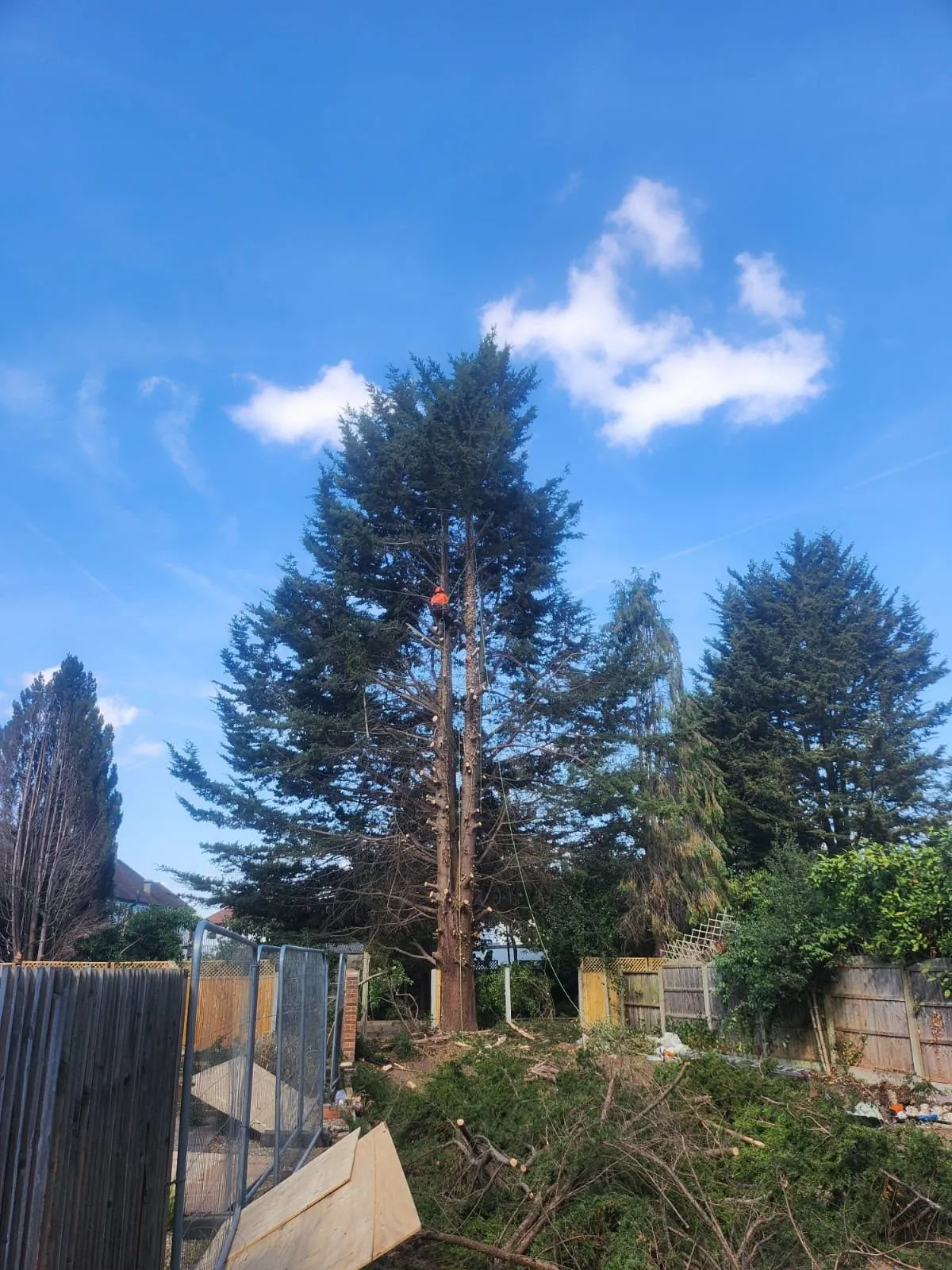
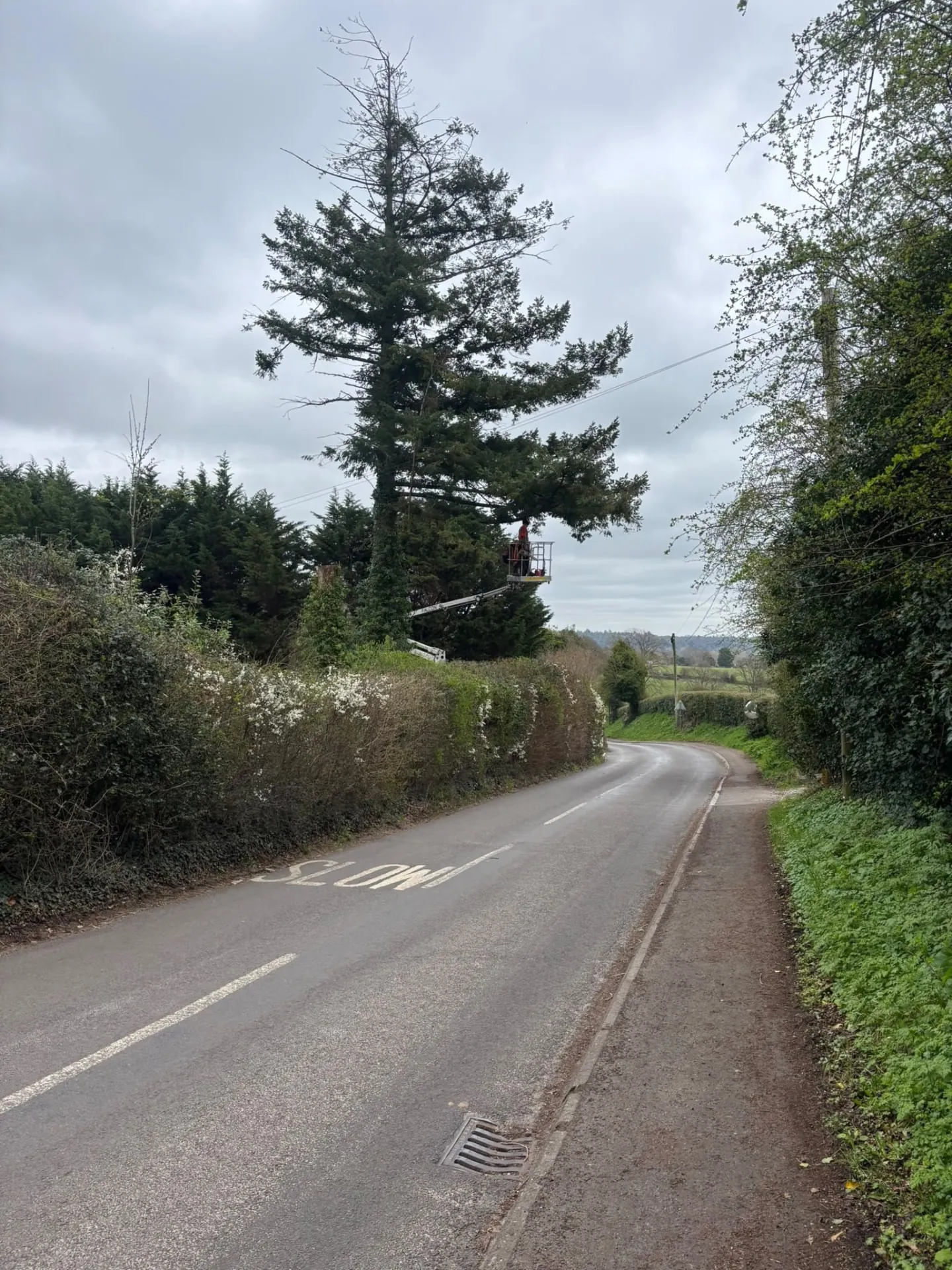
What happens if a dangerous tree is left as it is
A hanging branch or a leaning tree rarely gets safer on its own. Every hour it is left is another hour of risk to whoever walks, parks or sits underneath it.
The damage spreads
A split trunk or torn limb left in place can shed bark, break further under its own weight, or bring down additional branches in the next spell of wind or rain.
Property damage gets worse
A branch resting on a roof, gutter or fence can keep moving as the tree settles, turning a small repair into a larger one on the building underneath.
Access becomes harder
A fallen tree across a driveway, path or garden blocks movement and can trap vehicles or bins until it is cut and cleared.
Common mistakes we see
- ✕Attempting to cut a fallen or split tree without the right equipment, which is one of the most common causes of serious injury in gardens after a storm.
- ✕Waiting to 'see if it settles' rather than getting a professional to assess whether the tree is structurally sound.
- ✕Standing or parking underneath a hanging branch while waiting for help to arrive.
- ✕Removing small debris but leaving the main hazard (the leaning trunk or hung-up limb) untouched.
How it works
How an emergency callout works
- 01
Call and initial assessment
You describe what has happened and where the tree or branch is. Where photos help, we ask for them so we arrive with the right equipment.
- 02
On-site inspection
We check how the tree has failed, what it is resting on, and what is still under tension or hung up in neighbouring canopies before any cutting begins.
- 03
Making the area safe
Barriers go up, the surrounding area is cleared of people, and the sequence of cuts is planned so nothing is removed in a way that lets the tree move unexpectedly.
- 04
Removal and dismantling
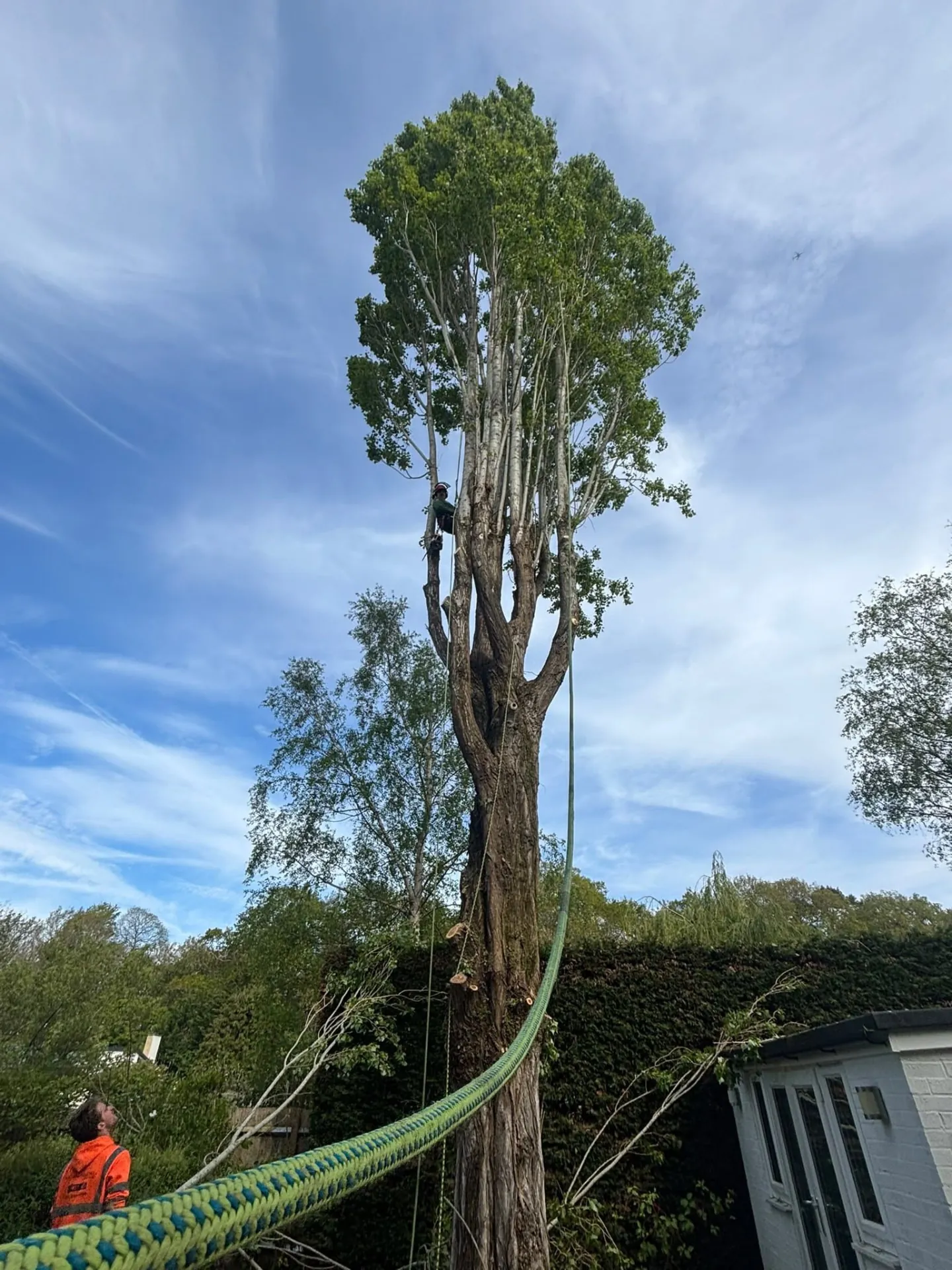
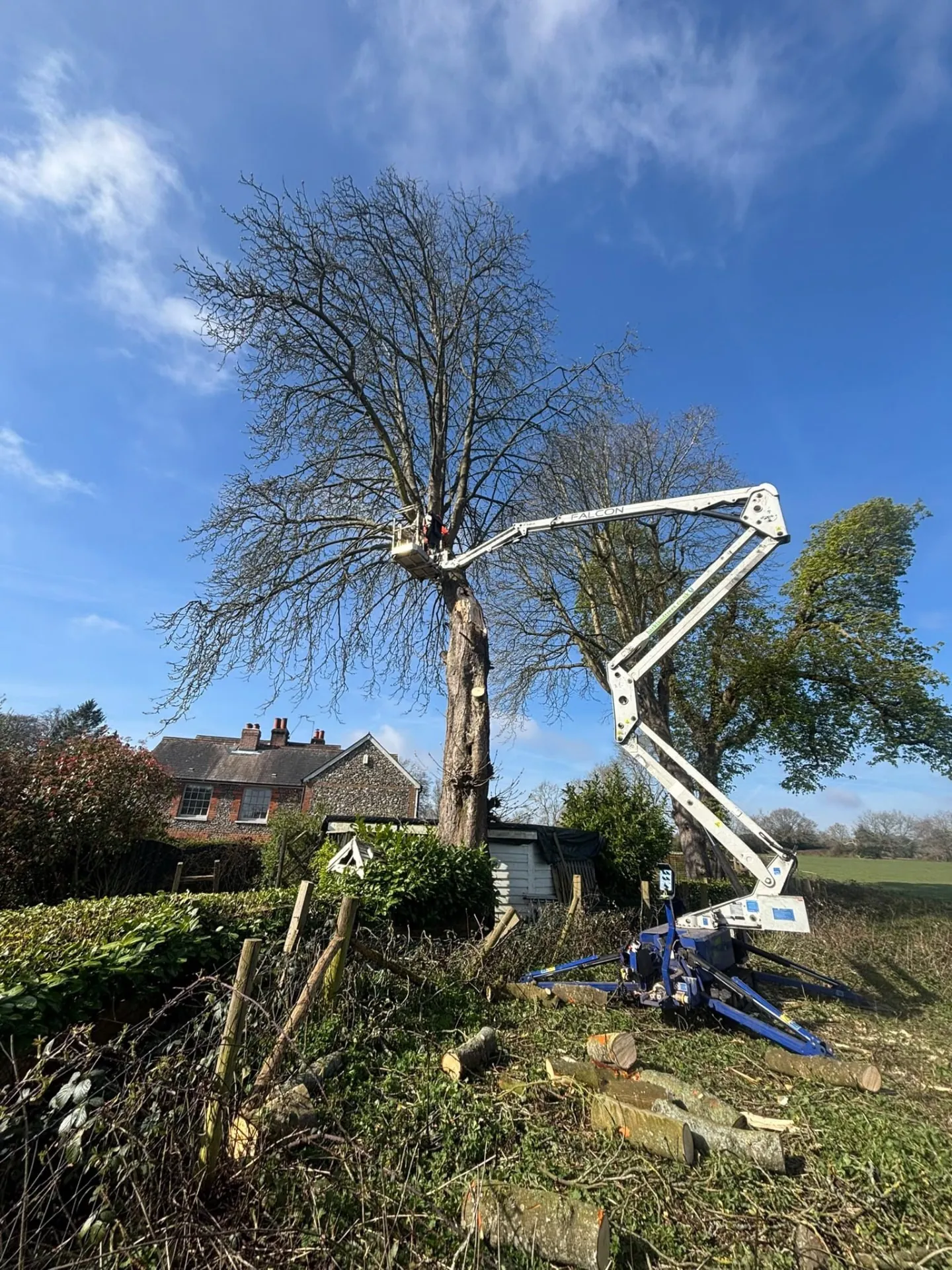
The tree or limb is cut down in sections, lowered or craned clear of buildings, vehicles and boundaries, using rigging where the space is tight.
- 05
Site clearance
Timber, brash and debris are cleared and removed as registered waste carriers. The site is left usable, and you pay once the work is finished.
Why call a professional for emergency tree work
Fast assessment
A trained eye can tell the difference between a tree that needs removing now and one that can safely wait, which stops unnecessary panic or unnecessary delay.
Safer outcomes
Cutting a tree under tension or hung up in a neighbour's canopy is one of the highest-risk jobs in arboriculture. NPTC and LANTRA training covers exactly this.
Less property damage
Planned rigging and sectional dismantling keep timber away from roofs, cars, fences and flower beds rather than letting it drop freely.
No upfront cost
There is no deposit to find while you are already dealing with storm damage. You pay once the tree is down and the site is clear.
Full site clearance
Brash and timber are removed as part of the job, so you are not left with a pile of debris to deal with yourself.
Cover for the whole job
£2 million public liability insurance is in place for the entire visit, from the first cut to the final clear-up.
In detail
Understanding emergency tree situations
Common causes of emergency tree work
Most emergency callouts follow high winds, heavy snow load, lightning strikes or long-term decay that finally gives way. A tree does not need to be large to be dangerous: a mature branch thirty feet up can do serious damage to a car or conservatory roof on the way down.
Root plate failure is another common cause, particularly after prolonged rain has saturated the ground. A tree that looks upright can have a root system that has already partly lifted, which is why a visual check from a distance is not enough to judge whether it is safe.
Fallen trees versus hung-up trees
A tree that has come fully to the ground is generally more predictable to deal with than one that has fallen partway and is hung up in a neighbouring canopy. Hung-up trees carry stored energy and can shift or drop without warning, so they are treated with particular care and often require winching or controlled sectioning rather than a straightforward cut.
Residential and commercial emergencies
Domestic gardens, shared driveways, commercial yards and roadside boundaries all present different access and risk profiles. A tree down in a tight residential garden needs careful rigging to protect fences, sheds and neighbouring plots, while a commercial site may need wider access routes kept clear for staff, deliveries or customers during the work.
What we do not do
Tree Preservation Orders and conservation area consent are the customer's responsibility to check before work goes ahead, including in an emergency where a tree poses an immediate danger. We will always discuss what is being removed and why, but obtaining any necessary consent sits with the landowner.
Related services
Areas we cover
Kingston upon Thames, Ealing, Farnborough, Richmond upon Thames, Watford, Maidenhead, Beaconsfield, Hammersmith, Fulham, Guildford.
Emergency Tree Work FAQs
How much does emergency tree work cost?+
Pricing is not published online because every emergency is different in scale and access. We give a quote on the phone or on site, there is no deposit to pay, and you only pay once the work is completed.
How quickly can you attend?+
Emergency callouts are taken as they come in and we work to get to genuinely dangerous situations as soon as we reasonably can, but we do not promise a fixed response time because every job and every day's workload is different.
What counts as an emergency?+
Storm damage, a fallen tree, a split or leaning trunk, or a branch resting on a building, vehicle or power line all count. Routine pruning or tidying is not treated as an emergency.
Do you work outside normal hours?+
Yes, for emergencies. Routine tree work is carried out 7am to 6pm, seven days a week, but emergency callouts for storm damage and fallen trees are covered 24/7.
Do I need to pay a deposit?+
No. No deposit is taken for any job, including emergencies. Payment is made once the tree has been removed and the site is cleared.
Is there a guarantee on emergency work?+
No written guarantee is offered on any job. What we do commit to is that you are not asked to pay anything until the work on site is finished.
Will the tree grow back or cause further problems?+
Once a hazardous tree or limb has been removed, the immediate danger is gone. Whether the remaining stump or tree regrows depends on species, and that can be discussed on site if stump grinding is also wanted.
Which areas do you cover for emergencies?+
We cover Kingston upon Thames, Ealing, Farnborough, Richmond upon Thames, Watford, Maidenhead, Beaconsfield, Hammersmith, Fulham, Guildford and the surrounding areas.
What should I do while I wait for help to arrive?+
Keep people, pets and vehicles well away from the area underneath the tree, avoid attempting to move or cut any part of it yourself, and if a branch is resting on a building or power line, treat that boundary as out of bounds until the tree has been assessed.
Can emergency tree work include garden clearance?+
Garden clearance is offered alongside tree work rather than as a standalone service, so any debris from the emergency, including broken branches scattered across the garden, is cleared as part of the same visit.
Get a dangerous treemade safe today
Call now for a free assessment. No deposit, no obligation: you pay only once the tree is down and the site is clear.
NPTC & LANTRA qualified · £2m insured · No deposit